

When I began writing software, it never occurred to me that there was something like “Declarative programming”, a paradigm that most Software Engineers abide by. As a beginner in the field of programming, you learn the basics — building blocks of Software Engineering — and then start applying them in your own projects. As time went by and I became more experienced with my craft, I learned that it’s not just about learning how to code but also understanding what you’re building and how to go about doing so.
As I continued embarking on more projects, working at different companies and working with different clients, I started to understand the meaning of scalable applications; one which can be easily maintained over a period of time while more features are added. This meant that I needed to move towards using a declarative approach that would let me focus less on syntax and more on functionality. Then I bumped into an article that talked about “Imperative vs Declarative Programming” and its impact on how we write code.
What is Imperative Programming?
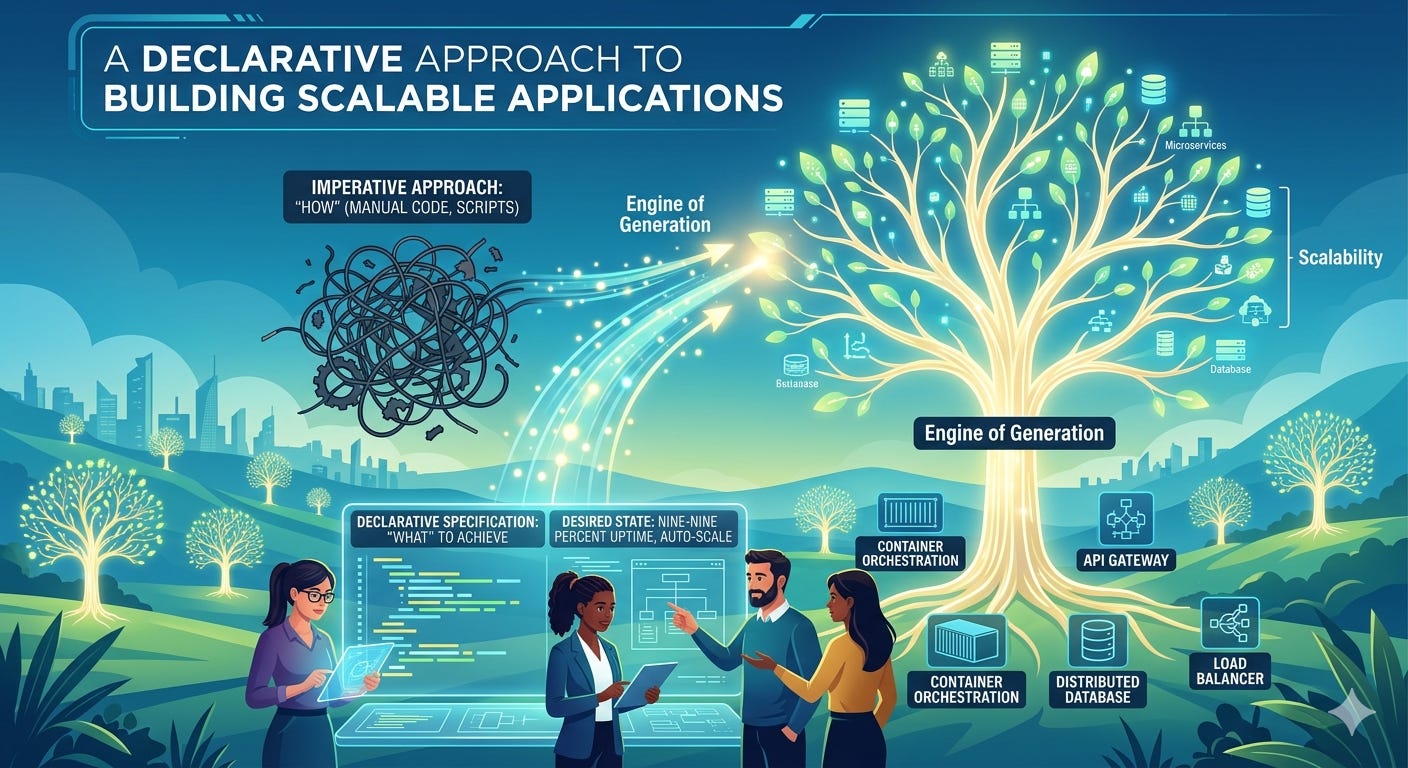
This is a type of programming paradigm where instructions or commands need to be described explicitly for each step required during execution. With this paradigm, one is more concerned with the “how” to get a desired outcome.
const ages = [10, 20, 30, 40];
const doubledAges = [];

// We are manually managing the loop state and the array mutation
for (let i = 0; i < ages.length; i++) {
  const result = ages[i] * 2;
  doubledAges.push(result);
}

console.log(doubledAges); // [20, 40, 60, 80]
In the code snippet above, you will notice that we are giving the computer a step-by-step recipe. If we forget to initialize the doubledAges array or mess up the loop index, the code fails.
Let’s see how this compares to Declarative Programming.
What is Declarative Programming?
As the name suggests, in this approach we describe what the program does, without explicitly telling it how to do so.
const ages = [10, 20, 30, 40];

// We describe what we want: a mapped version of the original array
const doubledAges = ages.map(age => age * 2);

console.log(doubledAges); // [20, 40, 60, 80]
In the code snippet above, we don’t care how the loop works; we just define the transformation from input to output.
In the two examples above, both approaches achieve the same result, but they differ on how to go about it. Declarative programming is a layer of abstraction on top of imperative programming. It leverages on the steps already mapped out either using loops and conditionals behind the scenes or by defining an algorithm for the sole purpose of achieving a specific goal. For example, creating utility functions that one can use in their project for specific tasks.
Real case scenario: A Real-time Search Input
A search bar with real-time suggestions as a user types into it is one of the key features of any e-commerce website today. You would want your users to be able to provide search queries while also getting relevant results quickly. The goal is to:
Listen to user input.
Wait for the user to stop typing.
Ignore duplicate search terms to avoid redundant queries.
Fetch data from the server.
Show results only for the latest search request.
Let’s look at how we would do this with an imperative approach (The “How”)
// Component variables
private searchTimeout: any;
private lastSearchTerm = '';
public results = [];

onSearch(event: any) {
  const term = event.target.value;

  // 1. Manually handle debouncing
  clearTimeout(this.searchTimeout);
  this.searchTimeout = setTimeout(() => {

    // 2. Check if the value is actually different
    if (term !== this.lastSearchTerm) {
      this.lastSearchTerm = term;

      // 3. Trigger the API call
      this.searchService.getResults(term).subscribe(data => {
        this.results = data; // Potential "Race Condition" bug here!
      });
    }
  }, 300);
}
In the code above, we are manually managing state variables. This to some extent is a “fragile” way because a developer could easily forget to clear a timeout or handle an out-of-order API response. If the first search takes 5 seconds and the second takes 1 second, the first search might overwrite the second search’s result when it finally arrives, leading to what we call a race condition. Manual timeouts and subscriptions can lead to memory leaks if the component is destroyed (moving from one page to another).
Let’s see how this looks with a declarative approach (The “What”)
// Define the "stream" once
readonly searchResults$ = this.searchControl.valueChanges.pipe(
  debounceTime(300),           // Wait for 300ms pause
  distinctUntilChanged(),      // Only act if the text changed
  switchMap(term =>            // Cancel previous request and switch to new one
    this.searchService.getResults(term)
  )
);
With the use of libraries such as RxJS, we treat the input as a stream. We describe the journey of the data rather than the steps that need to be taken along the way.
Self-cleaning:
switchMapautomatically cancels the previous HTTP request if a new one starts, hence avoiding any potential race conditions.No state to manage: We don’t need
lastSearchTermorsearchTimeoutvariables as the logic is “pure”.Async pipe: By using
searchResults$ | asyncin the template (HTML), Angular handles the subscription & unsubscription automatically.
Conclusion: Engineering for Longevity
The shift from Imperative to Declarative programming is more than just a technical pivot; it’s a shift in how we handle complexity. While imperative code might feel faster to write in the short term, it creates a “hidden tax” of technical debt, where every new feature increases the risk of side effects and race conditions.
By adopting a Declarative Mindset by leveraging tools like RxJS in Angular, we move away from micro-managing the machine instructions and toward describing the logic of the business.
Why this matters for your project:
Maintainability: New developers can understand what the system does without deconstructing how every loop is managed.
Predictability: Pure transformations and immutable data flows mean fewer “it works on my machine” bugs.
Scalability: Systems built on streams are naturally prepared for the high-concurrency demands of modern enterprise applications.
At Unstacked Labs, we don't just ship features; we architect solutions that are resilient to change. Whether we are optimizing an Angular frontend or scaling a backend architecture, our commitment to declarative principles ensures that your codebase remains an asset, not a liability.